

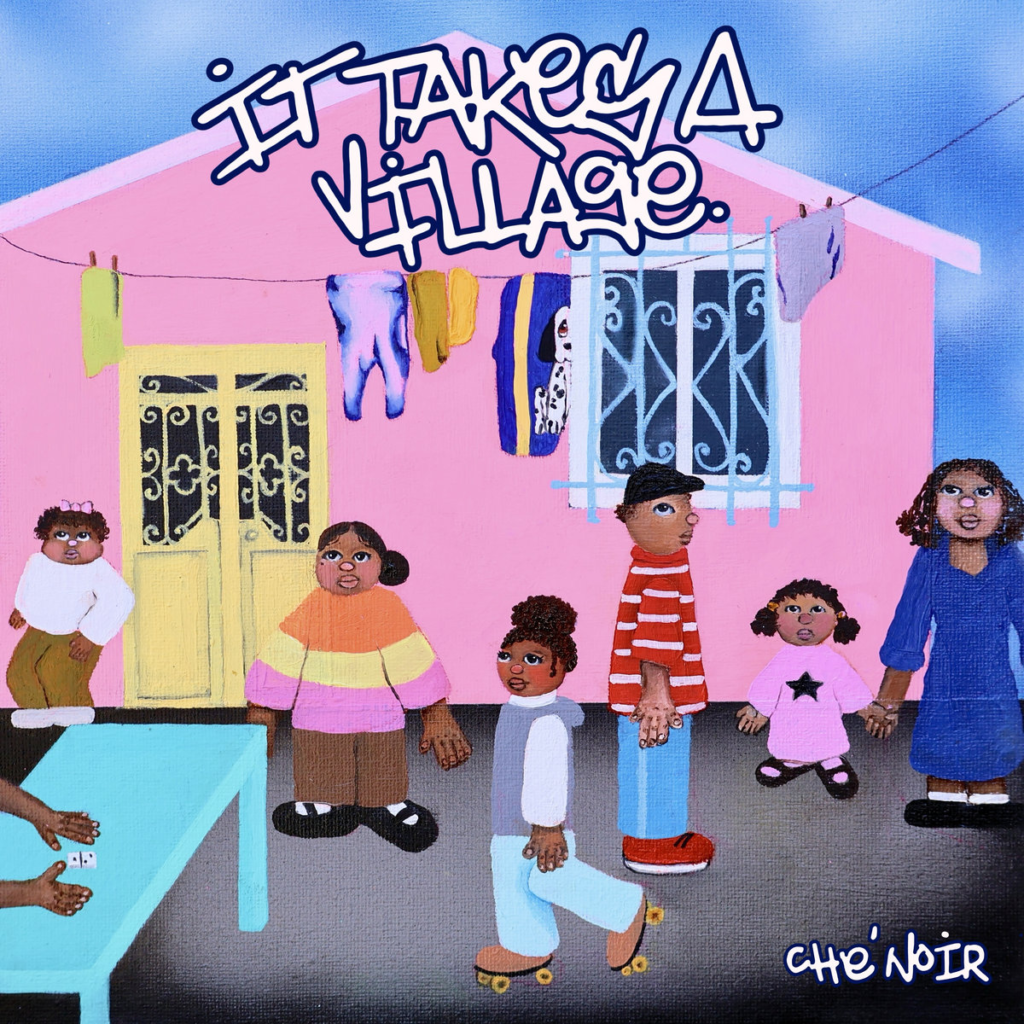
Buffalo-born rapper and producer Che Noir has released her new album, It Takes A Village, bringing together a powerful lineup of underground hip-hop artists and respected producers for a 12-track project centered on personal growth, family and the experiences that shape an artist’s life.
Released on October 23, 2026, through Poetic Records, the album features appearances from Black Thought of The Roots, Havoc of Mobb Deep, Ransom, Bruiser Wolf, The Uce and Jynx716. Its production lineup includes Conductor Williams, Mathematics, Nottz, DJ Design, Chuck Strangers and other beatmakers associated with lyric-focused hip-hop.
The project represents another important release for Che Noir, who has steadily developed a reputation for detailed writing, self-directed artistry and a commitment to independent hip-hop. Now based in Atlanta after growing up in Buffalo, she uses the album to explore how her experiences and relationships have shaped her identity.
Rather than relying on commercial trends, It Takes A Village stays close to the gritty production and thoughtful lyricism that have defined much of her catalog. However, the album also introduces a more personal dimension, reflecting the responsibilities and changes that come with building a family and navigating adulthood.
Che Noir Expands Her Sound Without Abandoning Her Roots
Che Noir has spent several years establishing herself as one of the distinctive voices in independent East Coast hip-hop. Her music combines direct storytelling with carefully selected production, allowing her lyrics to remain central to the listening experience.
Her previous releases have included collaborations with producers such as Apollo Brown and Big Ghost Ltd., helping establish a catalog that appeals to listeners who value lyricism and underground production.
With It Takes A Village, she continues that approach while working with a broader collection of established producers.
Havoc, one half of the legendary Queensbridge duo Mobb Deep, produces “Urban Essence” and “A Caged Mockingbird.” His contribution connects Che Noir’s contemporary work with the dark, sample-driven sound associated with classic New York street rap.
Nottz produces “My Village,” while Conductor Williams contributes to “Conductor’s Interlude” and “Wasted Time.” Mathematics, known for his long-running association with Wu-Tang Clan, produces “Fame & Fiction,” featuring Black Thought.
The variety of production styles gives the album different textures without taking it away from its central identity. The project remains grounded in hip-hop’s tradition of pairing strong lyricists with producers who understand how to create space for detailed verses.
For Che Noir, the result is a record that builds on her established sound while allowing more room for personal reflection.
Black Thought Joins Che Noir on “Fame & Fiction”
One of the album’s biggest highlights is “Fame & Fiction,” featuring Black Thought, the Philadelphia rapper widely regarded as one of hip-hop’s most accomplished lyricists.
As a founding member of The Roots, Black Thought has built a career around intricate wordplay, controlled delivery and detailed writing. His appearance creates a natural connection with Che Noir, whose music similarly places lyrical ability ahead of spectacle.
The track is produced by Mathematics, adding another important name to an already impressive collaboration.
“Fame & Fiction” was released ahead of the full album as part of its promotional rollout. The single gave listeners an early look at the project’s direction and highlighted Che Noir’s ability to work alongside a veteran lyricist without losing her own voice.
The pairing is especially notable because both artists approach rap as a craft. Their work places emphasis on language, structure and the ability to communicate complex ideas through verses.
For fans of underground hip-hop, the collaboration is one of the album’s clearest attractions. It connects Che Noir’s independent career with an artist whose influence extends across multiple generations of rap.
Havoc, Conductor Williams and Nottz Shape the Production
The album’s production roster gives It Takes A Village much of its character.
Havoc’s contributions bring a connection to Mobb Deep’s Queensbridge legacy. His work has helped define the darker side of East Coast production, with stark samples and arrangements that complement street-oriented narratives.
Conductor Williams brings a different approach through his work on “Conductor’s Interlude” and “Wasted Time,” the latter featuring Ransom. Known for his collaborations with contemporary underground rappers, Conductor has become a prominent name among listeners who follow sample-driven production.
Nottz contributes to “My Village,” providing another layer of production experience. His career has included collaborations with respected artists across hip-hop, and his work on the album fits the project’s emphasis on strong writing and carefully constructed beats.
Mathematics adds his production to “Fame & Fiction,” while Chuck Strangers and ill Brown collaborate on the closing track, “Magic,” featuring Bruiser Wolf.
Rather than using one producer throughout the album, Che Noir draws on a collection of different styles while maintaining a consistent focus on lyricism.
That approach allows each track to establish its own atmosphere while keeping the project connected as a complete body of work.
Motherhood, Family and the Meaning of It Takes A Village
The album’s title provides the key to understanding its central themes.
The familiar phrase “it takes a village” refers to the importance of community and shared responsibility in raising children and supporting individuals through life’s challenges. For Che Noir, the idea also reflects the relationships and experiences that contribute to personal growth.
The project explores motherhood, family, relocation and the sacrifices involved in balancing personal responsibilities with an artistic career.
Tracks such as “Grandma’s Cookies” and “My Village” provide space for reflection on family history and the people who influence an individual’s development. “A Caged Mockingbird” explores more difficult emotional territory, while “Wasted Time” brings Ransom into a collaboration focused on thoughtful writing.
These themes expand Che Noir’s subject matter without abandoning the directness that has characterized her music.
The album’s personal focus also distinguishes it from projects built primarily around guest appearances or competitive lyricism. Although its collaborators are a major attraction, the central story remains Che Noir’s own.
Her decision to address parenthood and the support systems surrounding it gives the project a clear narrative. The album considers how an artist’s priorities can evolve as personal circumstances change, and how community can become increasingly important when balancing family and professional ambitions.
Buffalo Hip-Hop Continues to Build Its Independent Legacy
Che Noir’s career also highlights the continuing importance of Buffalo, New York, within the wider East Coast hip-hop landscape.
The city has developed a strong independent rap scene, with artists and producers building audiences through collaborations, consistent releases and distinctive musical identities.
Buffalo’s influence has grown through artists such as Benny the Butcher, Conway the Machine and Westside Gunn, whose work has helped bring greater attention to the region’s underground scene.
Che Noir represents another part of that story. Her catalog demonstrates how an artist can establish a reputation through careful songwriting and independent releases rather than relying entirely on mainstream radio exposure.
Although she is now based in Atlanta, her Buffalo roots remain important to her musical identity. It Takes A Village continues that connection while allowing her to explore experiences that extend beyond her hometown.
The album also demonstrates how independent artists can draw on relationships across different cities and generations. Its collaborators include figures associated with Philadelphia, New York and the broader underground hip-hop community, creating a project that reaches beyond one regional scene.
Why It Takes A Village Deserves Attention
With 12 tracks and a carefully assembled lineup, It Takes A Village gives Che Noir room to explore her experiences while working alongside some of hip-hop’s respected lyricists and producers.
Black Thought’s appearance on “Fame & Fiction” provides a major collaborative moment, while Havoc, Conductor Williams and Nottz give the album a strong production foundation.
More importantly, the project has a clear purpose. Its themes of motherhood, family, personal growth and community support give the music a sense of direction beyond the technical aspects of rapping and production.
For listeners who follow underground East Coast hip-hop, the album is another reason to pay attention to Che Noir’s continued development as an artist.
It Takes A Village does not attempt to reinvent her identity. Instead, it builds on the qualities that have established her reputation while introducing a more personal perspective on the responsibilities and relationships that shape her life.
With its October 23 release, the album adds another substantial entry to Che Noir’s catalog and reinforces her position as an independent rapper committed to thoughtful writing and purposeful collaboration.